

The biological sciences are no longer confined to the quiet observation of nature or the mapping of known genomes. We have entered an era of “active intervention,” where tools like CRISPR-Cas9 allow us to rewrite the code of life with surgical precision. For an undergraduate student sitting in a lecture hall today, the question isn’t just about learning how to splice a gene; it is about whether they should be the ones deciding if that gene ought to be spliced at all. Integrating ethics into the biology curriculum is no longer a luxury—it is a fundamental necessity for the modern scientist.
The pressure to perform at this level is immense, leading many scholars to seek out the best assignment help from platforms like MyAssignmentHelp to manage the rigorous documentation required in high-level lab courses. This support allows students to focus more on the conceptual and ethical frameworks of their research rather than getting bogged down in the administrative burden of heavy coursework. As the technical bar rises, the mental space for ethical reflection often shrinks, making external academic guidance a strategic choice for many aiming for honors.
The Power of Play: Why Ethics is a Technical Skill
When we discuss gene editing, we often focus on the “how”—the viral vectors, the guide RNA, and the protein structures. However, a biologist who lacks ethical training is like a pilot who knows how to fly but doesn’t know where the borders are. Ethical literacy provides a map. It teaches a student to anticipate the long-term consequences of “off-target” effects, not just in a DNA strand, but in a society. If we can edit out a hereditary disease, do we also have the right to edit in “desirable” traits?
Bridging the Gap Between Lab and Society
Science does not exist in a vacuum. Every breakthrough in the lab eventually trickles down to public policy, healthcare costs, and social equity. If biology students are not trained to speak the language of ethics, they lose their seat at the table when laws are being written. They become mere technicians rather than leaders. By studying the philosophy of science alongside molecular biology, students learn to defend their work against public fear while remaining humble about the limits of their knowledge.
Comparison: Technical vs. Ethical Frameworks in Biology
The table below outlines the core differences between a purely technical approach and an integrated ethical framework in biological research.
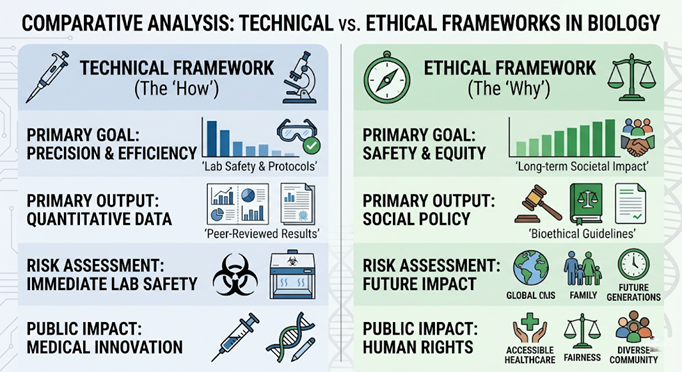
| Feature | Technical Focus (The “How”) | Ethical Focus (The “Why”) |
| Primary Goal | Precision & Efficiency: Achieving a successful edit or reaction with minimal errors. | Safety & Equity: Ensuring the intervention benefits society without causing harm. |
| Primary Output | Quantitative Data: Figures, charts, and peer-reviewed laboratory results. | Social Policy: Bioethical guidelines, public legislation, and moral frameworks. |
| Risk Assessment | Immediate Safety: Managing lab contamination, reagent stability, and physical hazards. | Future Impact: Evaluating intergenerational consequences and long-term ecosystem stability. |
| Public Impact | Medical Innovation: Development of novel treatments, vaccines, and genetic cures. | Human Rights: Protecting equitable access to tech and preventing genetic discrimination. |
Niche Research: Finding the Right Subject
For those entering their final years of study, selecting a dissertation topic that balances hard science with these societal questions is the key to a high-ranking paper. Exploring a wide range of biology research topics on the MyAssignmentHelp blog can provide the necessary inspiration for a thesis that stands out to examiners. Selecting a topic like “The Socio-Economic Impact of CRISPR in Agriculture” or “Gene Therapy and the Concept of Human Nature” allows a student to demonstrate both technical mastery and a sophisticated understanding of the world.
The Global Perspective on Bioethics
The ethics of gene editing isn’t just a Western concern; it is a global one. Different cultures have vastly different views on the sanctity of the germline. A student in London might view gene editing through the lens of the NHS and public health, while a student in Singapore or New York might see it through the lens of private biotech innovation. Studying ethics forces a student to adopt a global tone, acknowledging that their research could have a “butterfly effect” across continents.
Preventing the “Red Flags” in Research
One major concern in the scientific community is the “rogue scientist” phenomenon. When students are taught only the mechanics of gene editing without the weight of responsibility, the risk of ethical shortcuts increases. This is why major journals and funding bodies now require rigorous ethical statements. Learning how to write these statements is as important as learning how to pipette. It builds trust with the public and ensures that the scientific community remains self-regulating rather than facing heavy-handed government bans.
Human-Centric Science
At the end of the day, biology is the study of life. If we forget the “human” element—the families affected by genetic disorders, the farmers dependent on modified crops, and the future generations who will inherit our edited environment—then we are no longer practicing biology; we are practicing engineering. A curriculum that blends ethics with genetics ensures that the next generation of scientists is not just smart, but wise.
Frequently Asked Questions (FAQ)
1. Is gene editing currently legal for human use?
Ans: In most countries, gene editing is legal for research purposes and in “somatic” cells (non-heritable) for treating specific diseases like sickle cell anemia. However, “germline” editing (which affects future generations) is widely restricted or banned.
2. Why should a biology student care about philosophy?
Ans: Philosophy provides the tools for critical thinking. It helps scientists understand the “why” behind their work and enables them to communicate complex ideas to a public that may be skeptical of new technology.
3. How do I find a unique biology research topic?
Ans: Look for the intersection of two fields, such as “Biotechnology and Environmental Ethics” or “Genetics and Law.” Combining a technical subject with a social issue usually leads to the most original research.
4. Can I get help with my bioethics assignment?
Ans: Yes, many students use academic services to help structure their arguments and ensure their essays meet the high standards of university-level academic writing.
5. What is the biggest ethical risk of CRISPR?
Ans: The most cited risk is “unintended consequences,” where an edit in one part of the genome causes an unexpected mutation elsewhere, potentially leading to new health issues that could be passed down to offspring.
About The Author
I am Cooper Robinson, a Senior Academic Consultant and content strategist at MyAssignmentHelp with over a decade of experience in STEM education and research methodology.
